Saturday, 18 July 2009

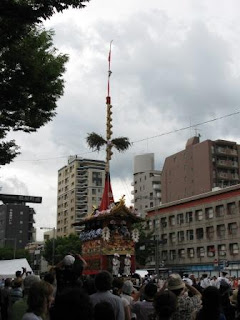
bits of Gion Matsuri festival

Gion festival, Kyoto
祇園祭(京都)


Gion Matsuri is the biggest festival in Kyoto. It runs during the whole month of July during which a variety of ceremonies and processions are conducted. It originated at the time plague attacked not only the city but swept through the whole country in the 9th century. People’s only defense was prayer.

They were convinced that the plague had been caused by a curse of the god Gozu-daiou and attended the Yasaka Shrine, where the god is enshrined, to pray for deliverance from the disaster. 66 halberd or hoko were stood at Shinsen-en garden to honour of the god of Yasaka and portable shrines were carried as well. It was called “Goryo-e” and was the origin of the festival. 66 floats each with a spear (hence the term hoko also applying to the float itself) were built, to represent the number of countries in those days and it was believed that hoko, which have sharp ends, would be suitable dwelling places for the spirits. Although there were breaks during the Onin War(1467-1477) and Second World War, it has otherwise been held annually for over 1,000 years.


The festivals are divided into 4 major parts: processions, bearing portable shrines, dedication rituals and ceremonies of the shrine. The most well-known part of the festival is a procession of hoko or floats which is held on the 17th of July. There are two types of hoko floats; one, hoko or halberd is larger and represents the original hoko used in the original ritual, the other, yama is smaller in size and usually carry historical figures and some carry figures based on mythology. Floats are built between the 10th and 13th of July and they are displayed on the street in the community each belongs to.


For three nights preceding the procession through central Kyoto the floats are decorated and hung with large numbers of lighted lanterns. People throng the streets strolling from float to float enjoying the festive atmosphere, playing games and eating at many stalls set up along streets during this time.


Especially the night before the procession, many of marchants' houses are open-fronted and display their treasure in the front room. It’s also called "Byobu Matsuri", literally meaning a folding screen festival. That is one of the great pleasures of the festival, to see the treasure and fine merchants' houses normally hidden.

(written with the big help of my friend)

Friday, 17 July 2009

Gion Matsuri festival

Gion festival, Kyoto
祇園祭(京都)

I apologize to anyone who follows my blog for not posting a while. I was away travelling around northern Japan. It was very pleasant, much cooler than here though there were many rainy days. I’d like to tell you about the places I visited, but I’ll do it soon when I sort out my photos. Instead I’ll tell you about my city’s biggest festival today.


The city has lots of festivals here and there, some are significant and some are not. The most loved and biggest in scale is Gion-matsuri festival, it runs almost the whole month of July. The best known part, and highlight, of the festival is the procession which was conducted today.


The last 3 nights the central area of the city was closed to all traffic and lots of stalls selling snacks line all the streets. I read that 100,000 people visited the city, many wearing yukata, the cotton kimono for summer, strolling in the massive crowds to enjoy the festival.


I didn’t go this year, but I live near by and the area is on my way to work so I saw the crowds gathering from early evening. It looked very packed as usual.

I most like the early morning scene with the big yamaboko floats resting peacefully in the quiet streets before the heat of the day builds up.

Sunday, 28 June 2009

Heian Shrine Shin-en garden

Shin-en garden, Heian Jingu Shrine, Okazaki Park, Kyoto
平安神宮 神苑(京都/岡崎公園)

I sometimes take guests to Heian (Jingu) shrine, but there aren’t many occasions we visit the garden partly because there’s an admission fee but mainly because of a lack of time.

Today I’ll show you its garden. The second week of June I was requested to take guests to the garden even though they had been to the shrine on a bus tour. I heard that they didn’t enjoy the shrine and it didn’t make any sense wishing to go there again.

When we arrived I finally understood they wanted to see its garden, not the shrine itself.


Japanese iris was almost in full-bloom and water lilies were just coming into bloom. The garden was breathtakingly beautiful.
I’ve been there many times and didn’t appreciate it much. The visit changed my opinion. The garden is transformed by the flowers. It is also a popular destination for cherry blossom viewing which should be lovely as well.


Those two buildings were transferred from the Imperial Palace when the garden was built in 1912 by a prominent gardener Ogawa Jihei, the pioneer of the modern Japanese garden.


Official site/The Garden (English)
Official site/Access (English)

Friday, 26 June 2009

A Thatching Village, Miyama

A Thatching Village, Miyama, Kyoto Pref.
京都美山 かやぶきの里 北村

It was 15:30 when I finish visiting Kozan-ji and decided to go further north along a meandering mountain road to Miyama, it was already 17:30 when I arrived.

Miyama is located in the central part of Kyoto prefecture, surrounded by mountains, actually the name Miyama means “beautiful mountains”.


The area is well-preserved and is as beautiful as the name suggests. I saw many of the thatched roofed houses the area is famed for and in particular the preserved area called “Kayabuki-no-sato” (Thatching Village). Out of around 50 of the village houses, 38 are thatched. 38 out of about 50 houses in this thriving village are thatched and most were built between the mid to late Edo period(1603-1867). To many visitors from around the country the place evokes the world of old Japanese stories. –Actually I thought of settling down when I visited the Shetland Islands. I might be easily fascinated with natural landscapes.

I was briefly tempted by the idea of living here too but realistically life without trains would be impossible at present.

It is undoubtedly an idyllic landscape, beautiful and peaceful.


access (Japanese)

Thursday, 25 June 2009

Kozan-ji temple in Togano'o

Kozan-ji Temple, Togano'o, Kyoto
高山寺 (京都/栂尾)

Unexpectedly I had a car available I went to Togano-o area. Togano-o is north west of Kyoto city and might take more than 1 hour bus ride from Kyoto station. -I took 40 minutes by car.

I didn’t have much time to visit, so I picked Kozan-ji temple to visit this time.


The temple used to have many structures, but only a few are left. The sub-temple “Sekisui-in” is the only one left from the Kamakura period (1185-1333) and designated as a National Treasure.


One of the reasons making Kozan-ji so popular is this series of drawings. “Choju-jinbutsu-giga” (Scrolls of Frolicking Animals and Scrolls of Frolicking Animals and Humans) is said to be the first “manga” and the motifs are still very very popular, and can be seen on various products. –Actually my rice bowl has this motif. A replica is on show. It consists of 4 volumes and the originals are kept by Tokyo and Kyoto National Museums, each with two volumes.


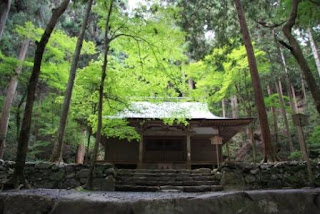
A stunning view from Sekisui-in. Though renowned for it’s autumn colours the early summer green, in Japanese called the season of “Shinryoku” (new green), is every bit as beautiful.


I wanted to see this tea field, said to be the oldest in Japan. The stone sign on the below makes this claim.


Entry is prohibited but as I was born in a tea producing area and tea and paddy fields were my childhood landscape I was interested in seeing what the oldest is like. As expected the field is nothing special…


The Kozan-ji is registered as a “World Heritage Site”.

The neighbouring mountains have two other well-known temples and usually visitors visit all three temples in one trip. The whole area is one of the most popular destinations for autumn colours, particularly Japanese maples. It must be utterly stunning. Most of the maples I saw there were very tall and much bigger than the ones in the city. I imagine that the temples would be covered with blazing red colours.