Thursday, 27 August 2009

Aomori Nebuta Festival

Aomori Nebuta Festival, Aomori
青森ねぶた祭 (青森/青森市)


August is the season for festivals. There are thousands of festivals throughout Japan. Aomori Nebuta festival is the one of the best-known and the crowds get bigger every year. I had wanted to see it for a long time and we happened to be near the site on the main day, so we grab the chance to see it.


Nebuta is famous for its floats which are carried around the centre of Aomori city. They are made from paper, wire and electric bulbs. They are beautiful to see in day light, but it absolutely stunning and breathtaking at night when they are lit from within. Each float is accompanied by its own band (hayashi-kata) and troop of “haneto” dancers.


It’s worth seeing if you are travelling in Japan in the first week of August.

There is an English website run by the festival committee and you can see the floats being carried through the streets on YouTube or other video sites.

Tuesday, 25 August 2009

a festival for children

Jizo-bon festival, Kyoto
地蔵盆

I live in central Kyoto surrounded by old wooden houses. If you ever walk in Kyoto city, you might have noticed the little shrines here and there on the street. They are shrines for Jizo and each community has own shrine. Jizo is a guardian of travellers and people, especially children.

Every 24th of the month is the day for Jizo and around the 24th of August many communities have a festival(Jizo-bon 地蔵盆) for the neighbourhood children. The number of children in my area has decreased and nowadays grandchildren who don’t live in the neighbourhood are allowed to join the festival.


What happens at the festival varies form place to place. Where I live the Jizo statue, usually displayed in the small shrine on the street, is displayed in one of the neighbourhood homes, a different one each year, and while a parish monk visits and chants the sutra in front of Jizo the children sit in a circle holding a big rosary that they pass through their hands because they are too young to read the sutra. In my home town the festival is held at a local temple and involves traditional bon-dancing (bon-odori 盆踊り) and some stalls selling food and the traditional game of catching goldfish with a paper scoop.

Saturday, 22 August 2009

the basic rules of taking Japanese bath

Most Japanese families have a bath (generally bath tub and space next to it to wash). In general bath and toilet are in separated rooms. A long time ago most families, especially in the city, didn’t have their own bath and people went to a public bath(sento/銭湯). In the country more family had baths, usually a detached building next to the toilet in the garden.

Let’s talk about the present day.

Japanese baths can generally be divided into 3 types: the private family bath, the public bath(sento/銭湯) and the hot spring bath(Onsen/温泉).
In all three types people share the same bath tub water, unlike a western bath, therefore you wash yourself before jumping into the water. Considering others and trying not to make the water dirty for those taking a bath later is very, very important. So the bath tub is not a place to wash your body but to soak and relax after getting clean.


Public baths and hot spring baths are usually bigger and communal. Some might even look like pool to you, but I advise you not to swim or splash unless you are all alone in the bath. I also advise not to wear swim suites even if you are embarrassed to be naked with strangers – the others are naked as well. Most baths are separated by gender. Unfortunately only a Japanese sign indicates which is which in most places, 男(male) usually blue or a dark colour sign and 女(female) usually red or pink.

Usually take a small towel or flannel to wash your body before getting into the bath, avoid dipping it into bath water, especially at hot springs, because it causes the water to get cloudy.


There might be other rules that I can’t think of right now because I take them for granted. I would be very happy if you let me know anything you think I’ve forgotten or ought to mention as well as anything you’d like to check or find out about.

The variety of Onsen(hot springs)

It is said that the Japanese love hot springs, Onsen(温泉). Hot springs are probably the most popular domestic travel destination. There are more than a thousand hot springs dotted around the country, but Kyoto is unusual in having very few. In recent years drilling to tap into geothermally heated underground water has become very, very popular and because of advanced technology we have so-called hot springs in the very central of big cities but personally I don’t consider these real onsens because they aren’t natural springs. They are more like sentos(銭湯) which I’ll explain in more detail in another post.


Tamagawa-Onsen, Akita Pref.Tamagawa Onsen, Akita Pref.

People in my area think of going to hot springs as a fun way to spend a couple of days but elsewhere attitudes can be different. One of the biggest differences is self-catering accommodation. Many onsens run both hotels and very basic self-catering facilities in Tohoku and people may stay a week, a month or even longer for medical reasons. This style is called “Tohji(湯治)”, literally meaning “hot water curing”. I had traveled to Tohoku before and was familiar with this kind of accommodation having stayed at some of the Tohji-yu (湯治湯 a hot spring for Tohji) but my husband was surprised to see our accommodation when we stayed Sukayu-Onsen(酸ヶ湯温泉) and whispered me that the place was more like a hospital than a hotel. –Actually the hotel looked like my wooden old elementary school building to me.


Sukayu-Onsen, AomoriSukayu Onsen, Aomori

Many of big Japanese hot spring ryokan/hotels open their baths to non-residents during the day. Visitors pay admission to take their bath which is often called “higaeri-nyuyoku(日帰り入浴)” which means day-return, thus we can visit many hot springs without staying in expensive hotels. Although part of the experience of staying at the hotel is the food as well.
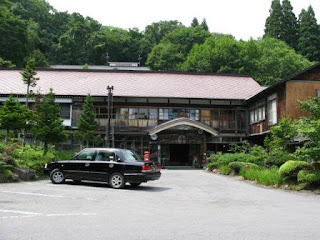

Thuta-Onsen, AomoriThuta Onsen, Aomori

There is a huge range of Japanese hot springs, from free outdoor hot springs to exclusive ryokans(Japanese inn) with 5-star cuisine; it depends on what you are looking for but there’s something to fit all tastes.


Yuze-Onsen, Akita Pref.Yuze Onsen, Akita Pref.

-I’ll tell you the very basic rules of how to take a Japanese bath next time.


Kuroyu Onsen, Akita Pref.Kuroyu Onsen, Nyuto Onsen-go, Akita Pref.

Wednesday, 19 August 2009

Travel to the North

Tohoku/ northern Honshu
東北地方


The last two months I had opportunities to travel around the north of Japan. I stayed at a hot spring in Akita in July and travelled around Akita and Aomori this month. The weather was much cooler and more pleasant than here, this is partly because I stayed mainly in the highlands but the climate is clearly cooler and less humid than that where I live.


It’s about 1,200 km from Kyoto to Aomori and it takes about 15 hours non-stop driving on the highway. I’ve done the drive north four times and am familiar with the route. I choose to take the highway to Niigata which takes 6 hours and general roads along Japan Sea to Akita. I had told my husband how much I’d enjoyed the trip north last time and we decided to go together so I wasn’t alone this time and he could share the driving. We both like driving in the countryside, without the stress and frustration of traffic jams or lights. We both had to work on the day we left Kyoto so we didn’t get away until 10 p.m. and arrived at the north of Akita at 3p.m. next day. Although it was tiring, I could enjoy the sunrise and the fresh air.


We drove through mountains and fields, saw falls and forests, visited 6 hot springs, saw a festival and fireworks, visited 3 archaeological sites and enjoyed local food, in total we drove a little over 3,200 km in 6 days.